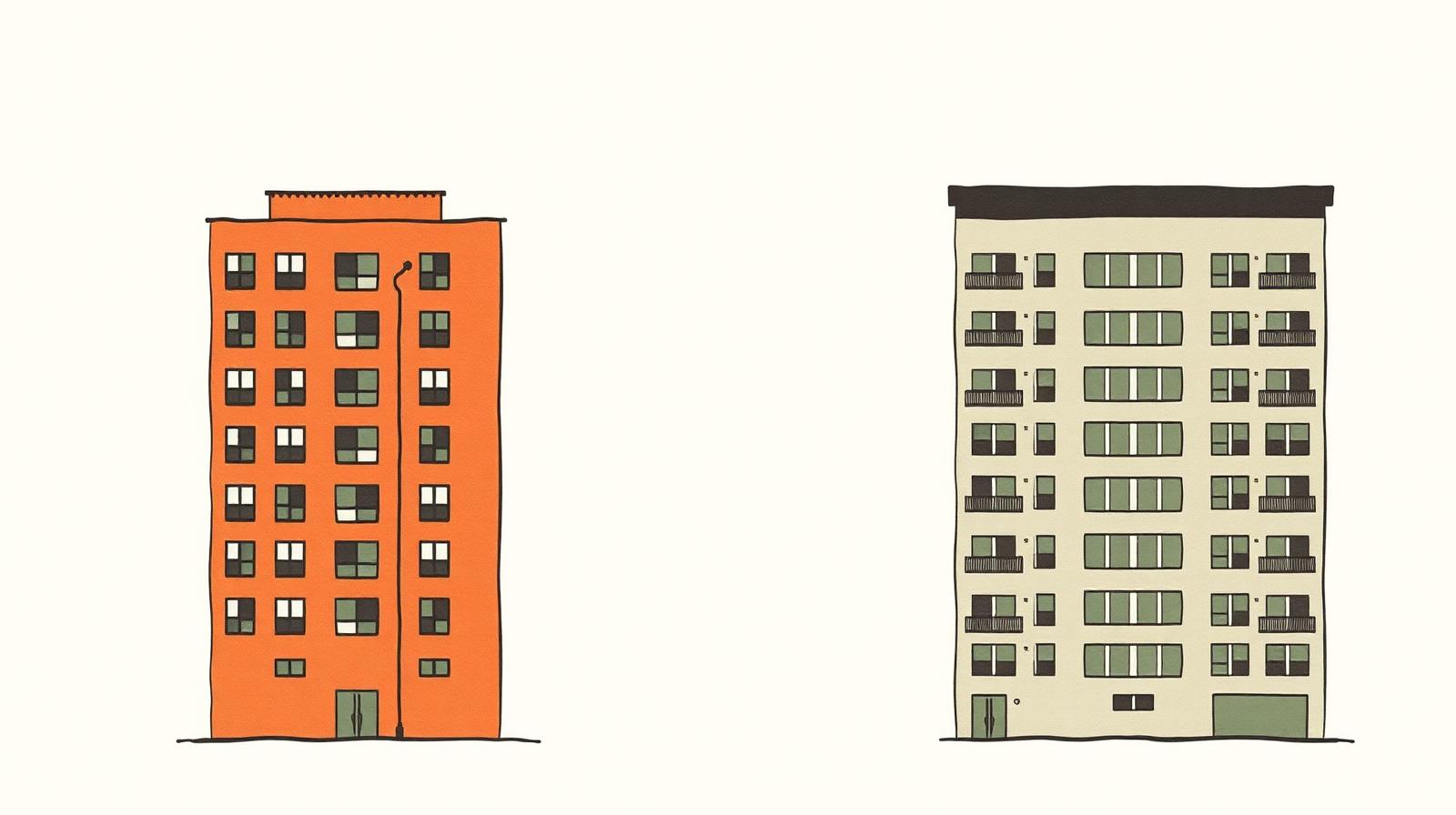
People use these terms interchangeably. They're not the same thing.
Rent control and rent stabilization are two distinct legal programs that limit how much landlords can charge for rent. They share a goal — keeping rents affordable for long-term tenants — but they operate through different rules, cover different units, and offer different protections.
Confusing the two costs renters money. A unit that's genuinely "rent-controlled" in New York City is rare and offers near-permanent rent protection. A unit that's "rent-stabilized" is common, but with weaker protections than many tenants assume.
This guide explains how each works, where they exist, and which one (if either) might cover an apartment you're considering.
The 30-second version
If you only read one paragraph:
- Rent control is an older, stricter, narrower program. In NYC, it generally applies to tenants who have lived in pre-1947 buildings continuously since 1971. Almost no new tenants qualify.
- Rent stabilization is the broader program that protects most regulated apartments in NYC. It limits annual rent increases and guarantees lease renewal rights, but rents can adjust over time within board-set guidelines.
- Most "rent regulated" apartments you'll encounter as a new renter are rent-stabilized, not rent-controlled.
- Outside NYC, the terms are used loosely. "Rent control" in Los Angeles or San Francisco usually means something closer to NYC's stabilization.
Now the detailed version.
Rent control (the original)
Rent control in the United States traces back to World War II, when federal price controls extended to housing in many cities to prevent wartime profiteering. Most cities phased out their rent control programs after the war. New York City kept its program — though significantly narrowed.
Modern NYC rent control specifically applies to:
- Tenants in buildings constructed before February 1, 1947
- Tenants (or their succession-eligible family members) who have continuously occupied the apartment since before July 1, 1971
- Specific limited categories under city and state programs
This is a tiny and shrinking population. As tenants pass away or move out, units exit rent control permanently. In 2024, fewer than 1% of NYC apartments were rent-controlled.
Rent control mechanics
- Rent increases are set by a Maximum Base Rent (MBR) formula recalculated every two years
- Increases are typically very modest (well below market or even below inflation)
- The tenant has near-permanent occupancy rights
- Succession rights exist for spouses and certain family members who have lived in the unit for two years
- When a rent-controlled tenant leaves, the unit typically converts to rent stabilization (not market rate)
Rent stabilization (the relevant one)
Rent stabilization is the program most renters actually encounter. It applies to roughly 1 million apartments in NYC alone, plus units in other cities.
Rent stabilization in NYC applies to:
- Buildings with 6 or more units constructed between 1947 and 1973 (mostly)
- Buildings receiving certain tax benefits (421-a, J-51, etc.)
- Some buildings that voluntarily entered the program
- Various other categories under specific programs
Rent stabilization mechanics
- Annual rent increases are set by the NYC Rent Guidelines Board (RGB) based on market conditions and operating costs
- Typical increases: 2–5% for one-year leases, slightly more for two-year leases (varies year to year)
- Tenants have the right to renew their lease — landlord cannot evict for "no reason"
- Succession rights exist for family members who lived in the unit for one year (two for non-immediate family)
- Specific procedures apply for eviction, including for non-payment
- Building must register with DHCR annually and provide tenants with rent registration documentation
Key NYC change in 2019
The Housing Stability and Tenant Protection Act (HSTPA) closed several pathways landlords previously used to deregulate units:
- Eliminated high-rent vacancy decontrol
- Eliminated high-income deregulation
- Limited Major Capital Improvement (MCI) and Individual Apartment Improvement (IAI) rent increases
- Made preferential rents the new legal rent for purposes of future increases (in most cases)
In short: HSTPA made rent stabilization stickier, harder to escape, and more renter-favorable.
Side-by-side comparison
- Buildings covered — Control: pre-1947 / Stabilization: 1947–1973 + others
- Tenancy required — Control: continuous since pre-1971 / Stabilization: any current lease
- Rent increase formula — Control: Maximum Base Rent (MBR) / Stabilization: RGB annual adjustments
- Typical annual increase — Control: very low, often below inflation / Stabilization: 2–5% (1-year), 4–7% (2-year)
- Lease renewal right — Control: permanent occupancy / Stabilization: yes, renewable
- Succession rights — Control: spouse + 2-year family / Stabilization: 1-year immediate family, 2-year other
- Share of NYC apartments — Control: <1% / Stabilization: ~50%
- Available to new renters — Control: effectively no / Stabilization: yes
Outside of NYC: terminology gets messy
In other US cities, "rent control" and "rent stabilization" don't follow NYC's strict distinction. The terms are used loosely and the underlying programs vary.
Los Angeles — Rent Stabilization Ordinance (RSO)
The LA RSO is often called "rent control" colloquially, but functions more like NYC's rent stabilization. Key facts:
- Applies to buildings constructed before October 1, 1978
- Covers properties with 2 or more units (apartments, duplexes, some single-family homes with ADUs)
- Allows annual rent increases tied to CPI (typically 3–8%)
- Provides just-cause eviction protections
- Maintained by the Los Angeles Housing Department (LAHD)
San Francisco — Rent Ordinance
SF's program also gets called "rent control" but operates similarly to stabilization:
- Applies to buildings constructed before June 13, 1979
- Excludes most single-family homes and condos (Costa-Hawkins Rental Housing Act exemption)
- Annual increases set by SF Rent Board (typically 1–2.5%, tied to inflation)
- Just-cause eviction protections
- Significant tenant protections including relocation assistance for certain evictions
Statewide California — AB 1482
California has a statewide rent cap applying to many buildings not covered by local programs:
- Buildings older than 15 years (rolling window — newer buildings age into coverage)
- Annual increases capped at 5% plus inflation, or 10% maximum
- Just-cause eviction protections
- Excludes single-family homes (unless owned by corporations) and certain other categories
Other cities
Several other cities have rent regulation programs with their own rules:
- Oakland and Berkeley, CA — local rent control programs
- Washington DC — Rental Housing Act applies to many buildings
- Newark and other NJ cities — local rent control programs
- Portland, OR — statewide cap applies (similar to AB 1482)
- Saint Paul, MN — newer rent stabilization program
- Some Massachusetts cities — pilot programs in progress
The rules differ in every case. Don't assume your city's "rent control" works like NYC's — check the local program specifics.
Cities and states without rent regulation
Many places have no rent regulation at all:
- Most of Texas
- Most of Florida
- Most of the Southeast
- Most of the Mountain West
- Several states preempt local rent control laws (Texas, Florida, etc., prohibit cities from creating programs)
In these markets, landlords can typically raise rents to any amount at lease renewal, subject only to the terms of the existing lease.
Why the financial difference is meaningful
Consider a hypothetical 10-year tenancy in NYC.
Market-rate apartment, starting at $3,000/mo:
- Annual rent increases of 5–8% (typical in non-regulated NYC)
- Year 10 rent: approximately $4,900–6,500/mo
- 10-year total rent paid: roughly $480,000
Rent-stabilized apartment, starting at $3,000/mo:
- Annual rent increases of 2–4% (per RGB)
- Year 10 rent: approximately $3,650–4,400/mo
- 10-year total rent paid: roughly $410,000
The stabilized apartment costs roughly $70,000 less over the decade. In some cases, where market rents in the neighborhood escalate sharply, the savings can exceed $100,000.
This is why rent stabilization is sometimes described as a "lottery ticket" — finding one substantially changes long-term financial outcomes for a renter.
Common misconceptions
- "Rent-controlled apartments still exist for new tenants." In NYC, generally no. New tenants typically receive rent-stabilized leases at best.
- "All older buildings are stabilized." False. Coverage depends on multiple factors including unit count, tax benefits, and prior deregulation.
- "Once stabilized, always stabilized." Mostly true now (post-2019), but not always historically. Units deregulated before 2019 generally stayed deregulated.
- "Stabilized rents can't go up much." The RGB sets increases annually — typically 2–5%, which compounds. Stabilized rents do go up, just less than market.
- "My landlord told me it's stabilized, so it must be." Verify independently.
- "Stabilized apartments have low rent." Not necessarily. The starting rent on a stabilized unit can be high. What's protected is the rate of future increase.
How to find rent-regulated apartments
If you're specifically looking for stabilized (or RSO/equivalent) units:
- Filter for them on platforms that surface regulatory status. Most listing sites don't. Some specialized tools do.
- Look in eligible building types. Older buildings with 6+ units in NYC; pre-1978 buildings in LA; pre-1979 in SF.
- Ask landlords directly. "Is this unit rent-stabilized?" If yes, ask for documentation.
- Verify before signing — request the DHCR / LAHD / SF Rent Board record yourself.
How Nook handles this
When you set up a search on Nook in a city with rent regulation, you can filter for verified rent-regulated units. We cross-reference listing addresses against the relevant public database (DHCR for NYC, LAHD for LA, SF Rent Board for SF) and surface badges only for confirmed matches.
This doesn't replace your own verification, but it does filter out the units that obviously aren't covered.