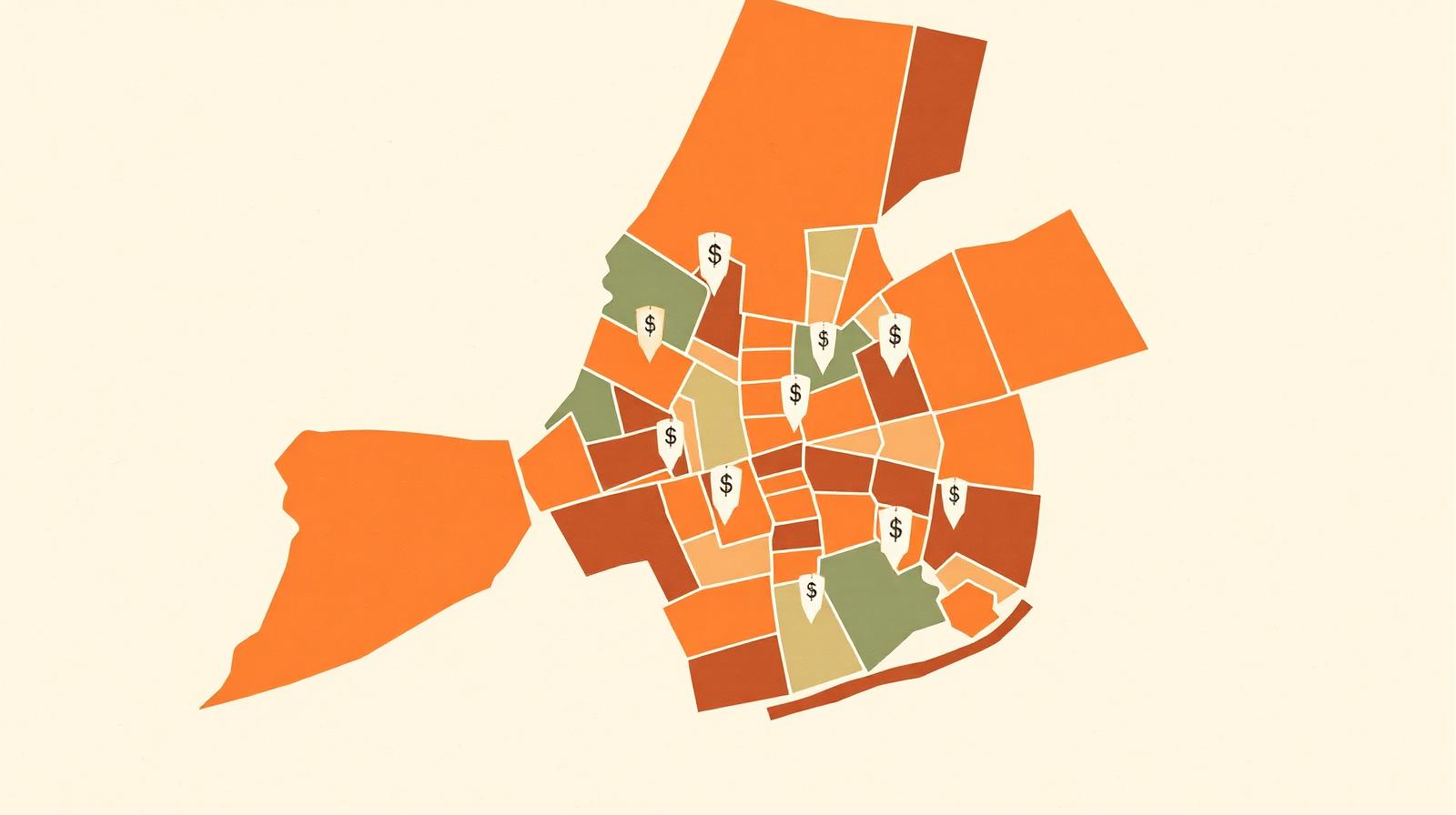
NYC rent ranges are confusing for two reasons. First, headline averages ("median rent in Manhattan is X") hide enormous neighborhood variation — a $4,000 median across Manhattan averages a $7,000 West Village 1BR with a $2,800 Inwood 1BR. Second, listing prices systematically lie. "Starting from $2,400" usually means "the worst unit in the building is $2,400 and the one you'll actually rent is $3,200."
This guide cuts through both problems. We'll walk through what specific budget levels realistically get you, neighborhood by neighborhood, with honest notes on what you'll compromise at each price point. We've kept the framing intentionally timeless — exact numbers shift every year, but the relative positioning between neighborhoods is remarkably stable.
If you're searching now, cross-reference our ranges against current market data — but use this guide for the relative comparisons it gives you.
How NYC rent works (the structural facts)
Before getting into prices, three structural facts shape every NYC rental:
1. Manhattan ≠ Brooklyn ≠ Queens ≠ Bronx ≠ Staten Island. Borough is the single biggest price determinant. The same square footage in Manhattan vs the Bronx differs by 2–3x. The same square footage in Williamsburg vs Bushwick differs by ~30%.
2. Subway access drives prices more than physical distance. A neighborhood 30 minutes from Midtown on a fast express line rents like a 30-minute neighborhood. A neighborhood 30 minutes from Midtown on a slow local plus a bus rents like a 45-minute neighborhood. Real estate prices reflect "subway time," not "map distance."
3. The "best deal" neighborhoods of any given year are the ones one stop further out than the trendy ones. Williamsburg was the deal in 2008. Bushwick was the deal in 2013. Bed-Stuy in 2017. Ridgewood in 2020. The frontier moves outward as each neighborhood gets discovered.
Manhattan averages by neighborhood
Manhattan prices are typically the highest in the city, with a clear hierarchy:
Premium tier — Tribeca, SoHo, West Village, Greenwich Village
1BR: typically $4,500–$7,500+
2BR: typically $7,000–$12,000+
Characterized by: historic character, cobblestone streets, premium amenities, fewer subway options than other parts of Manhattan but proximity to most of them
High tier — UES (south), UWS (south), Chelsea, NoMad, Murray Hill, Gramercy
Mid tier — UES (north), UWS (north), Hell's Kitchen, East Village, LES
1BR: typically $2,800–$4,500
2BR: typically $4,500–$7,000
Characterized by: significant variation by exact block, mix of doorman and walk-up buildings, strong restaurant/bar density (especially East/Lower East)
Value tier — Washington Heights, Inwood, Harlem (east), East Harlem
1BR: typically $1,900–$3,000
2BR: typically $2,800–$4,500
Characterized by: substantial savings vs other Manhattan tiers, longer commute to Midtown/Downtown (30–45 minutes), strong neighborhood character
Brooklyn averages by neighborhood
Brooklyn has the most variation of any borough — a $7,000+ Brooklyn Heights brownstone duplex is closer to Manhattan than to East New York.
Premium tier — Brooklyn Heights, DUMBO, Cobble Hill, Williamsburg (N), Park Slope (N)
1BR: typically $3,800–$6,500
2BR: typically $5,500–$9,500
Characterized by: Manhattan-style pricing, brownstone character (in heritage neighborhoods), waterfront proximity (DUMBO, North Williamsburg)
High tier — Williamsburg (S), Greenpoint, Park Slope (S), Carroll Gardens, Boerum Hill, Fort Greene, Prospect Heights, Clinton Hill
1BR: typically $2,800–$4,500
2BR: typically $4,000–$7,000
Characterized by: strong neighborhoods with good subway access, restaurant/cafe density, active rental markets
Mid tier — Bushwick, Crown Heights, Bed-Stuy, Sunset Park, Windsor Terrace, Kensington, Ditmas Park
1BR: typically $2,000–$3,200
2BR: typically $2,800–$5,000
Characterized by: pace of gentrification varies dramatically by block, subway access varies (L train Bushwick excellent; deep Crown Heights less so), strong community feel
Value tier — East Flatbush, Bath Beach, Bensonhurst, Sheepshead Bay, Canarsie, Coney Island, East New York, Brownsville
1BR: typically $1,500–$2,400
2BR: typically $2,000–$3,200
Characterized by: longest commutes (45–75 minutes to Midtown), most affordable Brooklyn rents, distinctive neighborhood cultures, less amenity density
Queens averages by neighborhood
Queens often offers the best price-to-quality ratio for renters who prioritize space over central location.
Premium tier — LIC (waterfront), Astoria (south, near Steinway)
1BR: typically $2,800–$4,500
2BR: typically $4,500–$6,500
Characterized by: newer construction common, fast subway to Manhattan (LIC especially), modern building amenities
High tier — Astoria (central/north), Sunnyside, Woodside, Forest Hills, Rego Park, Kew Gardens
1BR: typically $1,900–$2,800
2BR: typically $2,500–$4,000
Characterized by: solid subway access, diverse neighborhood character, good restaurant scenes (especially Astoria), family-oriented in spots
Mid tier — Jackson Heights, Elmhurst, Corona, Flushing (central), Bayside, Jamaica
1BR: typically $1,600–$2,400
2BR: typically $2,000–$3,400
Characterized by: extraordinary food diversity (Jackson Heights, Flushing), significant population density, longer commutes than inner Queens
Value tier — Far Rockaway, Rosedale, Jamaica (east), parts of Flushing (east)
1BR: typically $1,400–$2,000
2BR: typically $1,800–$2,800
Characterized by: longest commutes, most affordable rents, distinctive far-Queens identity
The Bronx, Staten Island
These boroughs typically offer the most affordable Manhattan-adjacent housing, with the longest commutes.
The Bronx
1BR: typically $1,400–$2,500
2BR: typically $1,800–$3,200
Premium pockets: Riverdale, Pelham Bay (relative)
Strong value across most of the borough
Staten Island
1BR: typically $1,500–$2,300
2BR: typically $1,800–$3,000
Premium pockets: St. George, Stapleton
Commute requires ferry plus subway
What specific budgets get you
Here's the practical breakdown — at each common budget level, what's realistic:
At $1,500–$2,000/mo (single tenant)
Realistic options:
Studios in deep Queens, Bronx, Staten Island
Shared apartments (with roommates) in most of Brooklyn and Queens
Rare 1BR finds in Washington Heights, Inwood, deep Brooklyn
Compromises:
Likely walk-up building
Older appliances and finishes
45–60 minute commute to Midtown
Smaller square footage (350–500 sq ft)
At $2,000–$2,500/mo (single tenant)
Realistic options:
Studios across more of Manhattan (Harlem, Inwood, Washington Heights, parts of UES/UWS north)
1BRs in mid-tier Brooklyn (Bushwick, Crown Heights, Bed-Stuy)
1BRs in mid-tier Queens (Astoria, Sunnyside, Woodside, Jackson Heights)
Comfortable shared apartments in most neighborhoods
Compromises:
Walk-up still likely
Limited amenities (no doorman, basic appliances)
Some buildings show their age
30–45 minute commute to Midtown
At $2,500–$3,000/mo (single tenant)
Realistic options:
Solid 1BRs in mid-Brooklyn neighborhoods (most of Bushwick, Bed-Stuy, Crown Heights, Sunset Park)
1BRs in better Queens neighborhoods (Astoria, Sunnyside)
Studios in trendier Manhattan/Brooklyn (East Village, LES, Williamsburg)
1BRs in Harlem, Washington Heights, Inwood
Compromises:
Still rarely doorman in mid-Brooklyn at this price
Building age varies — pre-war character or modern small building
25–35 minute commute to Midtown from most options
Square footage 450–650 sq ft typical
At $3,000–$3,500/mo (single tenant)
Realistic options:
1BRs in better mid-Brooklyn (Park Slope south, Fort Greene, Clinton Hill, Prospect Heights)
1BRs in Williamsburg, Greenpoint
1BRs in better Queens (south Astoria, LIC)
Studios in higher-tier Manhattan neighborhoods
Compromises:
Doorman buildings rare at this price (still possible in specific cases)
Modern renovated finishes more common
20–30 minute commute to Midtown
Square footage 500–750 sq ft
At $3,500–$4,500/mo (single tenant or couple)
Realistic options:
1BRs across most of Manhattan (excluding premium tier)
1BRs and small 2BRs in premium Brooklyn (Williamsburg, Park Slope)
Larger 1BRs / 1BR+ in Brooklyn Heights, DUMBO, Carroll Gardens
Comfortable 2BRs for couples in mid-Brooklyn
Compromises:
Doorman buildings start to be accessible
Renovated, well-maintained buildings more common
15–25 minute commute to Midtown
Square footage 600–900 sq ft
At $4,500–$6,000/mo (couple or single high-income)
Realistic options:
Solid 1BRs in premium Manhattan (Chelsea, West Village, Tribeca on the lower end)
2BRs across mid- and high-tier Manhattan
Premium 1BRs and 2BRs in Williamsburg, DUMBO, Brooklyn Heights
Doorman amenity buildings throughout the city
Compromises:
Even at this price, Manhattan square footage stays small (700–1,000 sq ft for 1BR)
Premium neighborhoods limit options
Building age varies — could be 1900s pre-war or 2020s new construction
At $6,000+/mo (high-income, families, luxury)
Premium 2BR and 3BR throughout the city
Penthouse and waterfront options
Limited only by personal taste and inventory in highly specific neighborhoods
The hidden costs nobody talks about
Beyond rent itself, NYC has hidden costs that add up:
Broker fees (if applicable). Post-FARE Act, most NYC apartments are no-fee to tenants. Some still aren't. See our broker fees guide for the full picture.
Utilities.
Electricity: $50–150/month depending on AC usage and unit size
Gas (if applicable for heat/cooking): $20–80/month
Internet: $50–100/month
Some buildings include heat; some don't (verify before signing)
Building amenity fees. Some buildings charge $50–200/month for gym access, package room, or other amenities beyond what rent covers.
Moving costs. $400–3,000+ for one move, depending on volume and service level.
Application fees stacking. NYC caps application fees at $20, but renters often apply to multiple buildings before getting accepted. Total spent: $40–200.
Renters insurance. $150–300/year, often required by lease.
Storage. For apartments without adequate closet space, off-site storage runs $50–200/month.
How to stretch your budget
If your target rent exceeds what your budget supports, real options exist:
Target rent-stabilized units. A genuinely stabilized 1BR can save $50–150/mo over a market-rate equivalent immediately, with the gap growing over years.
Focus on no-fee buildings. Skipping a broker fee can save $4,000–$6,000 upfront, which translates to roughly 1–2 months of effective discount on a 12-month lease.
Search in shoulder seasons. Late fall through early spring (November–March) sees more landlord flexibility on rent and concessions ("one month free," reduced security deposit). Same neighborhood, same building, 5–15% less.
Sign for longer terms. Two-year leases often have smaller annual increases than one-year leases. Useful if you're confident about the location.
Consider roommate math. A $4,000 2BR with one roommate ($2,000 each) often beats a $2,800 1BR — more space, lower individual cost, similar amenity access.
Look one neighborhood out. Bushwick is the "deal" version of Williamsburg. Crown Heights is the "deal" version of Prospect Heights. Inwood is the "deal" version of Washington Heights.
Time the search to landlord vacancy panic. Landlords lose money on every vacant day. Buildings with units sitting 3+ weeks are increasingly flexible. Check listing dates and prioritize the older ones.
What rents will likely do (general direction, not predictions)
We won't predict specific numbers. We will note structural factors:
NYC rent has historically tracked inflation plus 1–3% in normal years, with occasional spikes and rare declines
Newer construction typically pulls high-tier rents up by competing for affluent tenants
Rent-regulated units increase at the rate set by RGB (typically 2–5% per year)
Major economic disruptions (financial crises, pandemics) occasionally produce short-term declines, with recovery taking 2–5 years
Long-term direction over the past 40 years has been steadily upward
This guide refreshes annually. If exact numbers matter for your specific search, verify against current listing data on Nook.
Tagged
NYCRent pricesNeighborhoodsMarket Intelligence
Newsletter
Get a monthly digest
Best of the Nook blog plus product updates. No spam.